
Planning Your 2026 Supply Budget: A Step-by-Step Guide
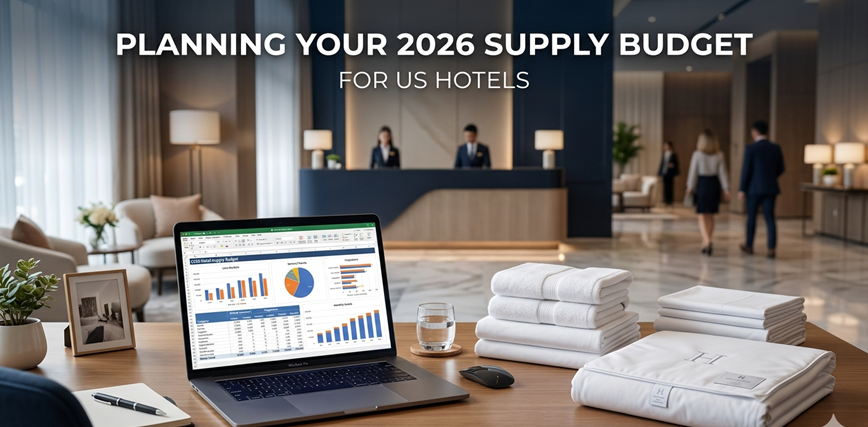
As 2026 approaches, smart hotel operators across the United States are already finalizing their supply budgets. With ongoing inflation pressures, fluctuating occupancy rates, and rising expectations from guests, a well-planned “hotel supply budget” can mean the difference between healthy profit margins and unexpected year-end shortfalls.
This step-by-step guide walks you through creating a realistic, data-driven 2026 supply budget that supports both operational efficiency and guest satisfaction.
Why Planning Your 2026 Supply Budget: Matters Now?
Supply costs represent 15–25% of a typical US hotel’s operating expense. From linens and towels to mattress protectors, toiletries, and platform bed bases, these items directly influence guest reviews and repeat business. Start “Planning Your 2026 Supply Budget” gives you time to negotiate better wholesale pricing, lock in contracts before potential tariff increases, and align purchases with projected occupancy.
According to the American Hotel & Lodging Association (AHLA), supply expenses can eat up 10-15% of operational budgets in mid-sized properties. Hotels that budget early often achieve 8–12% savings through bulk ordering and strategic supplier partnerships—money that can be reinvested in marketing or staff training.
Step 1: Assess Your Current Spending and Historical Data
Start with a deep dive into your 2024-2025 financials. Pull reports from your property management system (PMS) or accounting software like QuickBooks or Hotel Investor Tools. Categorize expenses: housekeeping supplies (e.g., linens, amenities), food and beverage (F&B) stock, maintenance items, and uniforms.
- Track trends: Did linen costs spike 12% last year due to higher turnover? Identify outliers.
- Benchmark against industry: Use AHLA data—average US hotel supply spend per room is $500-800 annually. If you’re over, flag it.
- Audit waste: Review inventory logs. Excess spoilage in mini-bars or overstocked toiletries signals poor forecasting.
Pro tip: Create a simple spreadsheet with columns for item, 2024 spend, 2025 spend, and variance. This baseline reveals hidden leaks, setting the stage for accurate 2026 projections.
Step 2: Forecast Revenue and Occupancy for 2026
Your supply budget ties directly to guest volume. Use tools like STR reports or Duetto for US market forecasts—expect 2026 occupancy to hover at 65-70% nationally, with urban hotels rebounding post-2025 events.
- Project room nights: Multiply expected occupancy by available rooms. For a 200-room hotel at 68% occupancy: 200×365×0.68=49,640200 \times 365 \times 0.68 = 49,640200×365×0.68=49,640 room nights.
- Factor in RevPAR growth: AHLA predicts 4-6% US RevPAR increase. Adjust supplies proportionally—more guests mean more shampoo bottles.
- Account for trends: Sustainability pushes (e.g., eco-friendly amenities) and tech upgrades (smart room controls reducing bulb replacements) will shift spends.
Build scenarios: optimistic (75% occupancy), base (68%), and pessimistic (60%). This range prepares you for economic shifts, like potential tariffs on imported goods.
Step 3: Categorize and Prioritize Supply Needs
a. Break your budget into clear categories for better tracking.
b. Bedding & Sleep Products: Sheets, pillows, mattress protectors, platform bed bases.
c. Bath Linens: Towels, bath mats, robes.
d. Guest Amenities: Toiletries, coffee kits, mini-fridge items.
e. Cleaning & Maintenance Supplies.
f. Furniture & Room Fixtures (if planning refreshes).
Assign each category a percentage of your total supply budget. For most US hotels, bedding and linens consume 40–50% of the supply allocation. Partners like Life Hotel Supply offer competitive pricing on high-quality, US-sourced essentials tailored for hotels.
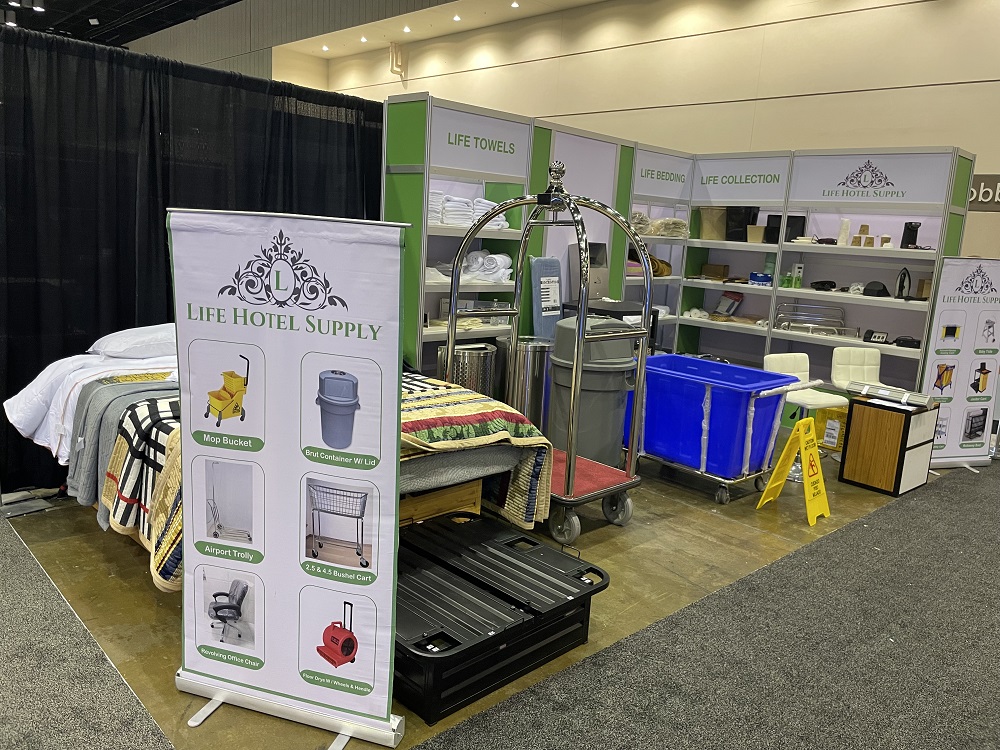
Step 4: Research 2026 Pricing Trends: Reach out to multiple suppliers for updated quotes. Key trends to watch in 2026:
- Continued modest increases in cotton and textile prices.
- Growing demand for sustainable, OEKO-TEX certified products.
- Stable or slightly lower pricing on commercial-grade metal bed frames due to increased domestic manufacturing.
- Build a simple comparison spreadsheet to track price-per-unit across vendors. Don’t forget to include shipping, lead times, and minimum order quantities.
Step 4: Categorize and Allocate Your Budget
Break your total budget into buckets based on Step 2 forecasts. For a mid-sized US hotel with $2M revenue projection, allocate 12% ($240K) to supplies. Customize this table to your property type—resorts need more outdoor gear, urban spots more urban wear.
| Category | % of Supply Budget | Estimated 2026 Cost (Example: 200-room hotel) | Key Tips |
| Housekeeping/Linens | 35% | $84,000 | Rotate stock to avoid degradation; buy durable microfiber. |
| Amenities/ Toiletries | 25% | $60,000 | Switch to bulk dispensers for 20% savings. |
| F&B/ Disposables | 20% | $48,000 | Forecast per cover; reduce plastic with compostables. |
| Maintenance/Uniforms | 15% | $36,000 | Preventive buys cut emergency spends. |
| Contingency | 5% | $12,000 | Buffer for surprises like HVAC filters. |
Step 5: Implement Cost-Saving Strategies and Sustainability
Stretch every dollar without skimping on guest experience.
- Go green: EPA-backed switches to LED bulbs and water-saving fixtures slash long-term costs by 15-20%.
- Tech integration: Inventory apps like MarketMan automate reorders, reducing overstock by 25%.
- Group purchasing: Join co-ops like AHLA’s for bulk deals—savings up to 18%.
- Vendor consolidation: Partner with one-stop shops like Life Hotel Supply for streamlined delivery and quality assurance.

Step 6: Review, Adjust, and Monitor Quarterly
Budgets aren’t set-it-and-forget-it. Schedule Q1 reviews against actuals.
- KPIs to track: Cost per occupied room (CPOR), inventory turnover ratio (COGSAverage Inventory\frac{\text{COGS}}{\text{Average Inventory}}Average InventoryCOGS), variance from forecast.
- Adjust dynamically: If Q1 occupancy dips, trim non-essentials.
- Annual audit: Post-2026, refine for 2027.
Conclusion: Turn Your 2026 Supply Budget into a Competitive Advantage
“Planning your 2026 hotel Supply budget” isn’t just about controlling costs—it’s about delivering consistent, high-quality guest experiences that drive positive reviews and repeat business.
By following this process, you’ll create a flexible, realistic budget that positions your property for success in a competitive market.
Start today: Gather your 2025 data, run your occupancy forecasts, and request quotes from trusted partners. Visit Life Hotel Supply to explore durable, affordable options that fit perfectly into your 2026 plan. Share this guide with fellow hoteliers and GMs in your network. Bookmark it for easy reference during your budgeting meetings, and return for more practical US hospitality management tips throughout the year.
A thoughtful supply budget today means stronger profits—and happier guests—tomorrow.
Your success starts with smart planning. Sweet dreams and steady margins ahead!